![Phrazle | Play Online Free [No Download]](https://phrazle.co.uk/wp-content/uploads/2025/11/phrazle-title.webp "Phrazle | Play Online Free [No Download]")
Are Word Games Good for Your Brain? The Science Behind Wordle
Phrazle 0
Can playing Wordle actually make you smarter? Research from universities including Harvard and Columbia
suggests that regular word puzzle play genuinely benefits your brain — improving memory, processing speed,
and even potentially delaying cognitive decline. Here’s what the science says, and which games offer the
biggest cognitive payoff.
What Happens in Your Brain When You Play Word Games
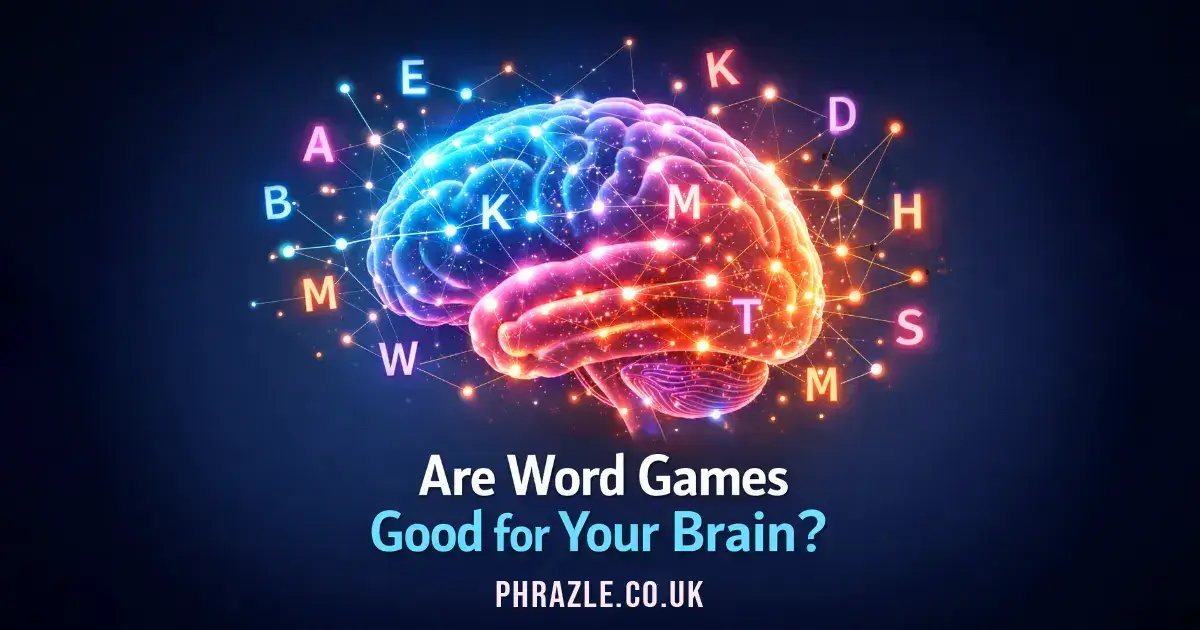
When you sit down to solve a Wordle puzzle, your brain isn’t just idly passing time. Neuroimaging studies
show that word puzzles activate multiple brain regions simultaneously:
- The prefrontal cortex (planning, strategy, and decision-making) — engaged when you
choose which word to guess next. - Broca’s area and Wernicke’s area (language processing) — active when you search your
vocabulary for words matching specific letter patterns. - The hippocampus (memory formation and retrieval) — recruited when you recall letter
positions, previous guesses, and vocabulary. - The anterior cingulate cortex (error detection and conflict monitoring) — fires when
you evaluate whether a guess makes sense given the clues.
In other words, a simple word puzzle creates a full-brain workout. Few daily activities engage this many
cognitive systems simultaneously in such a focused way.
The Research: What Studies Actually Show
Let’s look at what the peer-reviewed evidence says about word puzzles and brain health:
Memory and Processing Speed
A 2019 study published in the International Journal of Geriatric Psychiatry followed over 19,000
participants and found that people who regularly engaged in word puzzles performed significantly better on
tasks measuring attention, reasoning, and memory. The study found that frequent puzzle players had cognitive
function equivalent to people up to 10 years younger than their actual age.
Cognitive Reserve
Research from Columbia University’s Department of Psychiatry highlights the concept of “cognitive reserve”—
the idea that mentally stimulating activities build resilience against age-related cognitive decline.
Word puzzles contribute to this reserve by strengthening neural pathways and creating new connections,
essentially giving your brain more “backup circuits” to rely on as you age.
Neuroplasticity
Studies from Duke University have shown that learning and puzzle-solving promote neuroplasticity—the brain’s
ability to reorganise and form new neural connections. When you encounter a new word game mechanic (like
Phrazle’s purple tile system or Wordle Peaks’ directional clues), your brain builds new problem-solving
pathways that didn’t exist before.
Stress Reduction
A finding that surprised researchers: word puzzle players consistently reported lower stress levels.
The focused, absorbing nature of puzzle-solving creates a mild “flow state”—similar to meditation—where
anxious thoughts are temporarily displaced by concentrated problem-solving.
Which Cognitive Skills Do Different Word Games Train?
Not all word games exercise the same mental muscles. Here’s a breakdown of which games target which skills:
| Game | Primary Skills | Cognitive Benefit |
|---|---|---|
| Wordle | Deduction, vocabulary, pattern recognition | Logical reasoning, systematic thinking |
| Quordle | Multitasking, divided attention, prioritisation | Working memory capacity, attention management |
| Octordle | System thinking, scanning, rapid assessment | Processing speed, cognitive flexibility |
| Phrazle | Phrase recognition, contextual reasoning, lateral thinking | Language comprehension, creative problem-solving |
| Weaver Game | Step-by-step logic, word association, sequential planning | Executive function, planning ahead |
| Antiwordle | Reverse reasoning, constraint management | Cognitive flexibility, perspective-taking |
| Word Search | Visual scanning, pattern detection | Visual processing speed, sustained attention |
| Syllacrostic | Word construction, phonemic awareness | Language development, vocabulary expansion |
The “Varied Game” Advantage
Here’s something the research consistently shows: cognitive benefits are maximised when you engage in
varied mental activities rather than repeating the same one. Playing only Wordle every day still
helps, but adding different types of word games creates a broader cognitive workout.
Think of it like physical exercise. Running every day is good for you, but adding swimming, cycling, and
strength training produces better overall fitness. The same principle applies to brain training.
This is why I recommend building a diverse daily puzzle routine:
- Wordle for baseline deduction (2-3 minutes)
- Quordle or Octordle for multitasking (5-15 minutes)
- Phrazle or Weaver Game for lateral thinking (5-10 minutes)
- Word Search or Word Wipe for relaxation and visual processing (5-10 minutes)
How Much Time Do You Need?
Good news: you don’t need hours of daily puzzle time to see benefits. Research suggests that as little as
15-20 minutes of cognitively stimulating activity per day can produce measurable improvements in memory and
processing speed over time.
A quick Wordle game (3 minutes) followed by a Quordle session (8 minutes) already puts you over the
threshold. Add a Phrazle puzzle and you’re at a solid 20 minutes of varied cognitive exercise.
What the Science Doesn’t Say
In the interest of honesty, here’s what the research does not definitively prove:
- Word games won’t prevent dementia: They may delay onset and reduce risk, but they’re
not a cure or guarantee. Think of them as one part of a broader brain-health strategy that includes
physical exercise, social interaction, and good sleep. - Benefits plateau: Doing the exact same puzzle at the same difficulty every day
eventually produces diminishing returns. Your brain adapts, and the exercise becomes less stimulating.
This is why variety matters. - Transfer is debated: Whether skills gained from word puzzles transfer to real-world
cognitive tasks is still debated in the scientific community. Most researchers agree the transfer is
modest but real, particularly for tasks involving language, pattern recognition, and working memory.
Beyond Brain Health: Other Benefits
Word games offer benefits that go beyond pure cognitive function:
- Vocabulary expansion: Regular play exposes you to words you might not encounter in
daily life. Every Wordle answer you didn’t know is a new addition to your vocabulary. - Social connection: Sharing Wordle results, discussing strategies, and playing
competitive variants like Wordle VS create
genuine social bonds. - Morning routine anchor: A daily puzzle provides structure and a small sense of
accomplishment first thing in the morning—a positive start to the day. - Screen-time quality: Not all screen time is equal. Time spent actively solving puzzles
is cognitively superior to passively scrolling social media.
The Bottom Line
Are word games good for your brain? The science says yes—with caveats. Regular, varied word puzzle play
genuinely improves memory, processing speed, and cognitive flexibility. It won’t make you a genius or
prevent all cognitive decline, but it’s one of the most enjoyable and accessible ways to keep your brain
active and healthy.
The best part? These benefits come from something you’d probably do anyway because it’s fun. You don’t have
to force yourself through brain-training apps that feel like homework. Just play the word games you enjoy,
vary your routine, and know that every puzzle solved is a small investment in your long-term brain health.
Start your brain workout: Play Wordle |
Play Quordle |
Play Phrazle