![Phrazle | Play Online Free [No Download]](https://phrazle.co.uk/wp-content/uploads/2025/11/phrazle-title.webp "Phrazle | Play Online Free [No Download]")
The History of Wordle: From Personal Gift to Global Phenomenon
Phrazle 0
Wordle went from a private gift between partners to a global phenomenon played by millions — then sold to
The New York Times for a reported seven figures. Here’s the full story of how a Welsh software engineer
named Josh Wardle created the most viral word game in internet history.
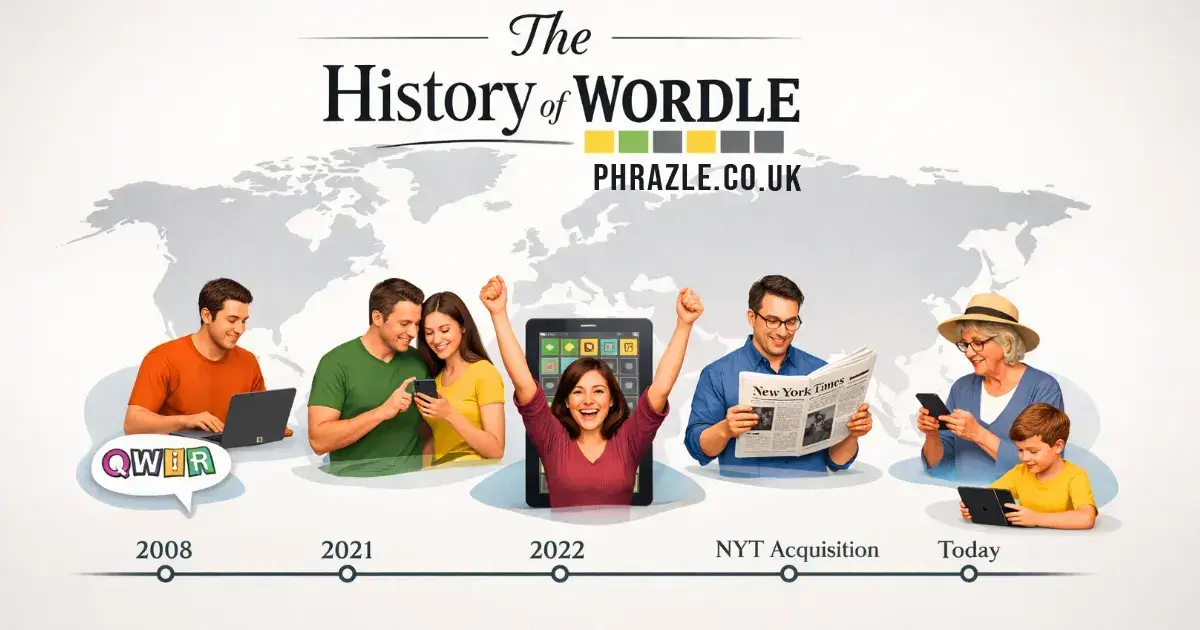
The Beginning: A Game Built for Love
Wordle’s origin story is one of the most charming in gaming history. In 2013, Josh Wardle — a Welsh
software engineer living in Brooklyn, New York — built a prototype word-guessing game. He called it
“Mr. Bugs’ Wordy Nugz” (yes, really). It wasn’t very good, and he shelved it.
Fast forward to 2020. During the COVID-19 pandemic, Wardle and his partner Palak Shah became obsessed
with The New York Times’ daily puzzles, particularly Spelling Bee and the crossword. Inspired by their
shared love of word games, Wardle revisited his old prototype, refined the mechanics, and renamed it
“Wordle” — a play on his own surname.
The game was originally built for just one person: his partner. It was a personal gift, not a product.
He shared it with family members via a private link, and for months, it stayed within that tiny circle.
Going Public: October 2021
In October 2021, Wardle made Wordle available to the public on a simple website with no ads, no
tracking, and no monetisation. The design was deliberately minimalist — a grey grid, coloured tiles,
and nothing else.
At first, almost nobody played. By November 2021, the game had approximately 90 daily players. Most
of them were Wardle’s friends and family.
Then something unexpected happened.
The Viral Explosion: The Emoji Grid
A group of players in New Zealand created an informal system for sharing their results on social media.
They used coloured emoji squares — green, yellow, and grey blocks — to represent their guesses without
revealing the answer. It looked something like this:
⬜🟨⬜⬜⬜
🟩⬜🟨⬜⬜
🟩🟩🟩🟩🟩
Wardle saw this organic sharing behaviour and did something brilliant: he built it directly into the
game as a “Share” button. Players could copy their colour grid and paste it to Twitter, WhatsApp,
or any messaging platform.
This single feature turned Wordle into a viral phenomenon. The emoji grids were inherently shareable —
they showed off your result without spoiling the answer, creating a natural format for friendly
competition. Social media feeds filled with colourful grids, and curiosity drove millions of new
players to the game.
The Numbers Tell the Story
| Date | Daily Players | What Happened |
|---|---|---|
| November 2021 | ~90 | Friends and family only |
| Late December 2021 | ~300,000 | Emoji sharing goes viral on Twitter |
| January 2022 | ~2,000,000 | Global media coverage |
| Late January 2022 | ~3,000,000+ | NYT acquisition announced |
From 90 players to 3 million in roughly two months. No marketing budget, no ads, no app store listing.
Just a simple game and the power of social sharing.
Why Wordle Went Viral: The Perfect Storm
Looking back, several design decisions — some intentional, some accidental — combined to create the
perfect conditions for virality:
One Puzzle Per Day
This was perhaps Wardle’s most important design choice. By limiting the game to a single puzzle daily,
he created artificial scarcity. You couldn’t binge Wordle. You played once, shared your result, and
had to wait until tomorrow for more. This made each puzzle feel special and prevented burnout.
Everyone Plays the Same Word
Unlike most puzzle games where each player gets a random challenge, every Wordle player worldwide
solves the same word on the same day. This created a collective experience — a shared daily ritual.
Colleagues could discuss “today’s Wordle” without knowing each other’s answers, just by comparing
emoji grids.
No Ads, No Accounts, No Friction
Wordle had no sign-up process, no cookies banner, no ads, no in-app purchases. You opened a webpage
and started playing. In an internet increasingly cluttered with pop-ups and paywalls, this felt
revolutionary. Wardle later said that keeping the game free and ad-free was essential to him — he
didn’t want to exploit the players’ attention.
The Perfect Difficulty
Six guesses for a five-letter word hits a sweet spot. It’s hard enough that you can fail (which makes
winning meaningful) but easy enough that most people succeed most days (which prevents frustration).
The difficulty curve works well.
The New York Times Acquisition
In January 2022, The New York Times announced it had acquired Wordle for “an undisclosed price in
the low seven figures” — widely reported as approximately $1 million to $3 million.
The reaction was mixed. Many players feared the NYT would place Wordle behind its paywall, add ads,
or change the word list. Some of these fears proved partially justified — the NYT did curate the
word list to remove potentially offensive answers and made some controversial changes to accepted
guesses.
But the core game remained free to play, and the NYT added features that many players appreciated:
- WordleBot: An AI analysis tool that evaluates your guesses and suggests
improvements. It assigns a “skill score” and “luck score” to each game. - Statistics tracking: Persistent stats across devices for logged-in users.
- Hard Mode refinements: Clearer rules and better enforcement of Hard Mode
constraints.
The Spinoff Explosion
Wordle’s success spawned hundreds of spinoff games, many of which have become hits in their own right.
The open-source nature of the original game (it ran entirely in client-side JavaScript) made it easy
for developers to create variations:
- Quordle — Solve four words
simultaneously. Became the most popular multi-word variant. - Octordle — Eight words at
once for puzzle addicts. - Phrazle — Guess entire phrases
instead of single words, with a unique purple tile mechanic. - Antiwordle — The reverse
challenge: avoid guessing the correct word. - Weaver Game — Change one
letter at a time to transform one word into another. - Wordle Peaks — Alphabetical
direction clues replace colour tiles. - Themed variants: Taylordle
(Taylor Swift), Wizarding Wordle
(Harry Potter), and dozens more.
These spinoffs kept the daily word puzzle trend alive long after Wordle’s initial viral wave subsided,
building a permanent ecosystem of browser-based word games.
Wordle’s Lasting Impact
Wordle didn’t just create a game — it changed how people think about browser-based gaming:
- The “daily puzzle” format became a standard template for casual games. Dozens of
non-word games adopted the one-puzzle-per-day model. - Social sharing in games shifted from screenshots and video clips to abstract,
spoiler-free representations. - Minimalist game design proved that you don’t need flashy graphics, sound effects,
or monetisation to build a massively successful game. - Web-first gaming regained credibility. In an app-dominated world, Wordle proved
that a website was sometimes the better platform.
Where Wordle Stands Today
As of 2026, Wordle remains one of the most-played daily games on the internet. Under The New York Times,
it’s part of a broader puzzle ecosystem alongside the Crossword, Spelling Bee, Connections, and Strands.
The game has been translated into multiple languages and continues to attract new players daily.
Josh Wardle has largely stepped away from public life since the sale. In interviews, he’s expressed
satisfaction with his decision to sell, noting that the global attention and the rise of unauthorised
clones had become overwhelming for what was never intended to be a commercial product.
His creation, though, lives on — not just as a game, but as a daily ritual for millions of people
worldwide. And every spinoff, every emoji grid shared on social media, every competitive debate about
the best starting word, traces back to a love letter built during a pandemic by a software engineer
for his partner.